If you searched for "CPR classes New London NH," you probably need one of two things: a certification card for your job, or the confidence to help a family member in an emergency. Either way, the path is the same. Figure out which course fits your needs, choose a session that works with your schedule, and show up ready to practice. Semper Paratus CPR trains people across New Hampshire, Vermont, Massachusetts and southern Maine. You can see current options on our classes page. This guide walks you through the rest.
Finding CPR Classes in New London, NH
New London sits in a part of the state where people often live a few towns away from where they work. Neighbors in Sunapee, Newbury, Wilmot, Sutton, Springfield and Elkins may all be looking for the same kind of training.
When you look for a class, a few practical questions help narrow things down:
- What does your employer or school require? Some jobs ask for a specific course by name, such as BLS. Others just want proof of CPR and first aid training.
- How far are you willing to drive? In the Lake Sunapee region, a session that is a short trip down Route 11 or along I-89 may be the easiest fit.
- Do you need a card, or just the skills? Parents and grandparents sometimes take a class purely for peace of mind. Workers usually need documentation.
- When are you free? Weekday, evening and weekend availability varies, so check the schedule early if you have a deadline.
The simplest step is to browse our current class listings and compare locations and course types in one place.
Which Course Do You Need?
The word "CPR" covers several different courses. Picking the wrong one is a common and frustrating mistake, especially if your employer is expecting a particular card. Here is a general overview of the main types.
| Course type | Who it usually fits | What it generally covers |
|---|---|---|
| CPR/AED (adult, child, infant) | Teachers, coaches, camp staff, fitness workers, parents | Chest compressions, rescue breaths, using an AED, choking relief |
| Basic Life Support (BLS) | Nurses, EMTs, medical assistants, dental staff, healthcare students | High-quality CPR in a team setting, bag-mask use, AED, choking relief |
| First Aid | Workplaces, childcare, outdoor programs, households | Bleeding control, burns, allergic reactions, sudden illness, injuries |
| Combined CPR/AED and First Aid | Many workplace and childcare roles | Both sets of skills in one session |
If you are not sure, ask your supervisor, HR office or program coordinator which course name they need. Write it down exactly. That one step saves a lot of back-and-forth later.
A note on healthcare roles
If you work in a hospital, clinic, dental office or long-term care setting, or you are a nursing or allied health student, you will most likely be asked for BLS rather than a general CPR course. BLS is built around how trained responders work together, so it goes further than a community CPR class.
Who in the New London Area Takes CPR Training
CPR is not just for medical workers. In a community like New London, the list of people who benefit is long.
- Healthcare workers and students who need BLS for their jobs or clinical placements.
- College staff and students who work in residence life, athletics or campus programs.
- Teachers, coaches and childcare providers who are responsible for kids every day.
- Lake and outdoor workers, including camp counselors, marina staff and recreation leaders.
- Parents and grandparents who want to know what to do if a child chokes or stops breathing.
- Caregivers looking after an aging parent or a family member with a heart condition.
- Small business owners who want staff prepared for an emergency on site.
Summer brings visitors to the lakes, and winter brings skiers and snowshoers to the hills. Emergencies can happen in any season, often far from a hospital door. Knowing how to start CPR and use an AED means you can help in those first minutes before EMS arrives.
Ready to pick a session? Take a look at our upcoming classes and find one that fits your schedule.
What Happens in a Typical CPR Class
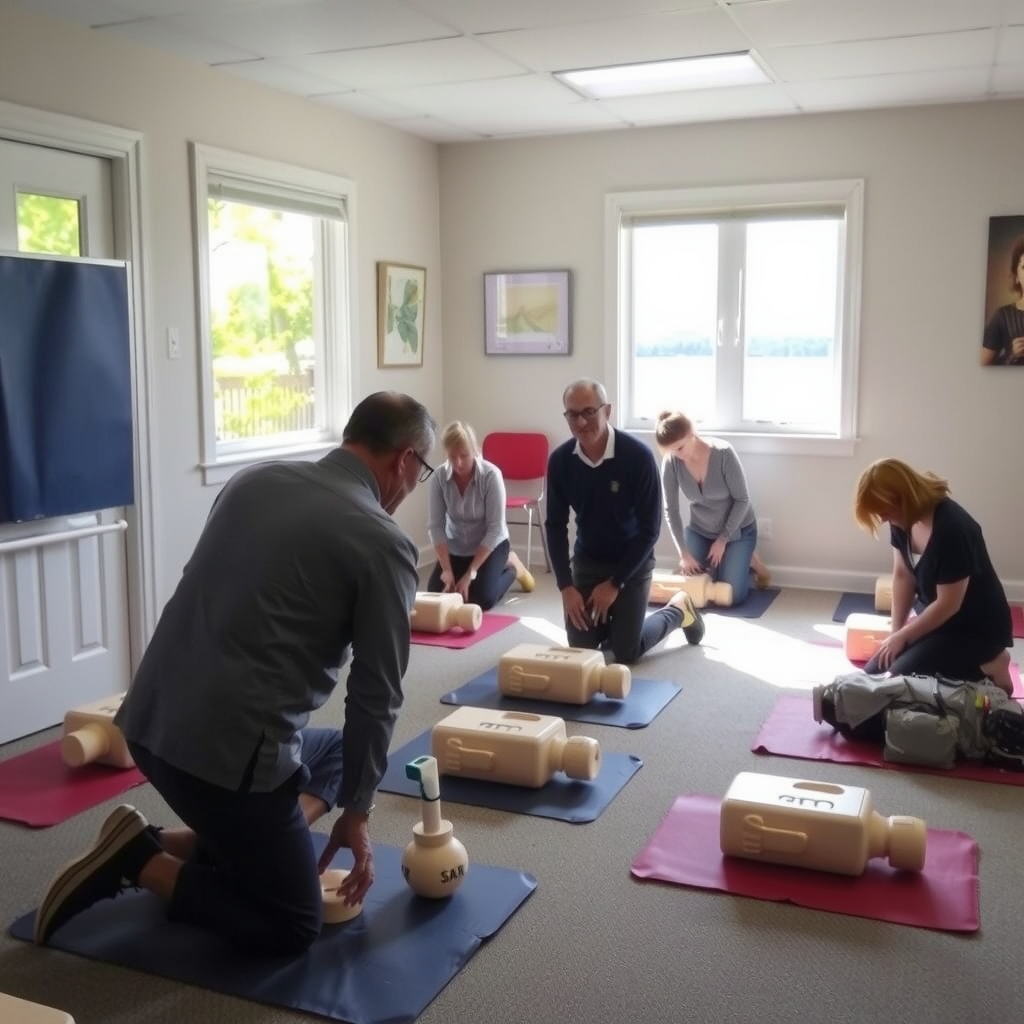
If it has been a while since you sat in any kind of class, don't worry. CPR training is hands-on and practical. Most of your time is spent practicing, not taking notes.
While details depend on the course, a class generally includes:
- Recognizing an emergency. How to check whether someone is responsive and breathing normally, and when to call 911.
- Chest compressions. Hand position, depth, rate and letting the chest rise between compressions. You will practice on manikins.
- Rescue breaths. How to give breaths using a barrier device, and how this differs for adults, children and infants.
- Using an AED. How to turn one on, place the pads and follow its prompts. Trainer units let you practice without any risk.
- Choking relief. What to do for a choking adult, child or infant.
- Skills check. For certification courses, an instructor watches you perform the key skills to confirm you can do them correctly.
CPR can be physically tiring. Kneeling on the floor and doing compressions for a couple of minutes is real work. If you have a knee, back or other physical concern, let your instructor know at the start. They can talk with you about how to approach the hands-on portion.
How to Prepare for Your Class
A little preparation makes the day go more smoothly.
- Dress comfortably. You will be kneeling and moving around. Clothes you can bend and stretch in are best.
- Confirm the course name. Double-check that it matches what your job or program requires.
- Bring what you are asked to bring. If your class has any pre-work or materials, complete or gather them ahead of time.
- Arrive a few minutes early. Winter roads around the Sunapee region can slow you down, so give yourself extra time from November through March.
- Ask questions. Instructors expect them. If something feels unclear during practice, speak up. That is what the class is for.
It also helps to think about your own situation before class. Do you care for an infant? Do you work alone at a remote job site? Bringing those scenarios to your instructor can make the training more useful for your daily life.
Keeping Your Certification Current
Getting certified is the first step. Staying current is the second.
CPR and BLS skills fade without practice, and certification cards come with an expiration date. Many cards are valid for about two years, but requirements vary by course and by employer. Some workplaces set their own schedule for refresher training.
For a closer look at timelines and what to do as your card nears its end date, read our guide on how often you need to renew your CPR certification.
A few habits make renewals easier:
- Put your card's expiration date in your phone calendar with a reminder a couple of months ahead.
- Keep a photo or digital copy of your card where you can find it quickly.
- If your employer tracks certifications, ask how they want proof submitted.
Renewing on time means you avoid a gap in coverage, which matters if your job depends on having a valid card.
Getting Started with CPR Training Near New London
Whether you work at a clinic, teach in a classroom, coach a youth team or simply want to be ready at home, CPR training is one of the most practical skills you can learn. The New London area is a close-knit community, and every person who knows CPR adds a little more safety to it.
Here is a quick recap:
- Identify the exact course you need: CPR/AED, BLS, First Aid or a combination.
- Check your schedule and how far you are willing to travel.
- Dress comfortably, arrive early and come ready to practice.
- Track your expiration date so you can renew on time.
If you are organizing training for a group, such as a workplace, school or community organization, reach out to ask what options may be available.
Take the next step today. Visit our classes page to see current CPR, BLS and first aid sessions and sign up for the one that fits you. We look forward to training with you.